Have you heard about burnout? Most probably, yes. But what about burnout? Or brownout?
Those are just three shades of disengagement at work – and obviously not the only ones.
- Burnout – exhaustion caused by overload, constant pressure, and emotional strain. Too much energy spent.
- Boreout – fatigue from boredom and lack of stimulation. Too little challenge or meaning.
- Brownout – when we lose our sense of purpose. We’re still working, but no longer understand why. We keep going on half power while our energy slowly drains. The term comes from the electrical “brown-out” – a drop in voltage when the light dims but doesn’t go out completely.
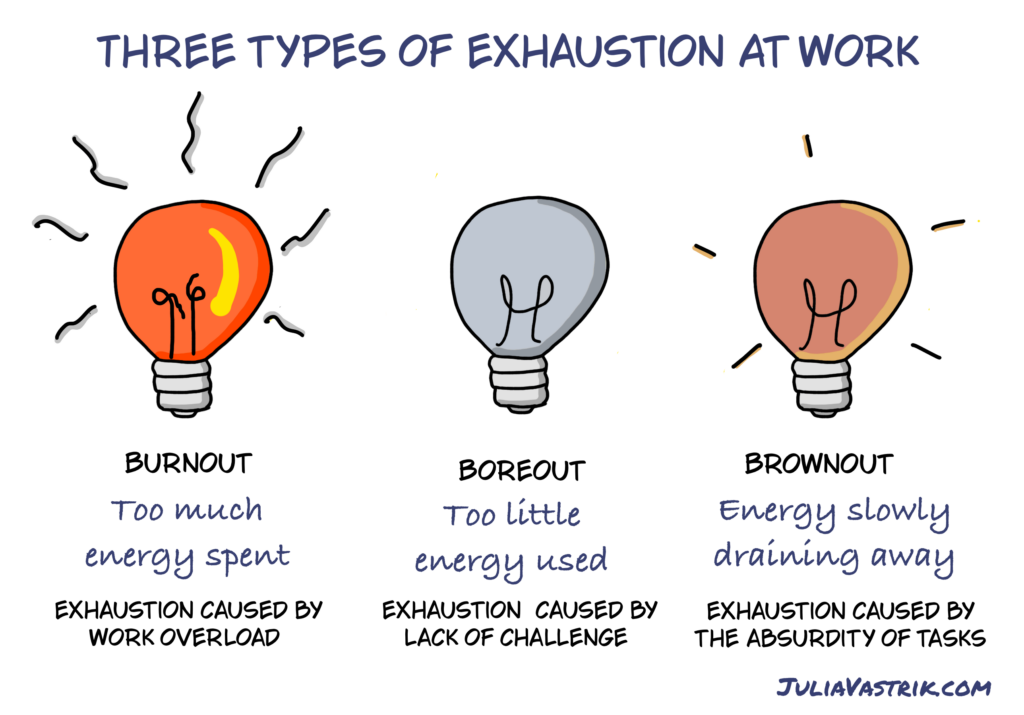
And sometimes this balance is very fragile – between too much, too little, and losing the “why”.
Most probably, you’ve recognized all of them. Throughout my career, I’ve been close to all three – maybe not fully in any of them, but sometimes just a few steps away. And while I believe much depends on us, the places we work and the environments we’re part of play a big role too.
What a waste it is when depersonalized organizations fail to use our full potential – our inner motivation to learn, grow, create meaningful work, and bring our creativity to life.
What is worse – burnout, boreout or brownout?
As dangerous as burnout can be, the scariest thing at work for me is brownout.
Meaningless tasks. The absurdity of work. Crazy procedures. Pointless processes. Artificial rules. Lack of sense. And facing all of it with your eyes wide open.
Brownout is a relatively new concept. Burnout is about too much. Boreout is about too little. Brownout is about meaning slowly disappearing from work. You are still there, still doing things, still functioning – but your energy keeps draining because what you do no longer feels useful or real. Absurdity takes over. Theater instead of actual work.
All this can make me feel quite miserable. And I doubt I am the only one. Most people want to do meaningful work. Something with a clear goal. Something useful for themselves and for others.
And still – how often do we create the opposite?
Not always because someone wants it that way. Good intentions are usually there. Often it just grows quietly – one strange process, one pointless step, one artificial rule at a time. And sometimes it accelerates fast.
How to overcome it?
One option is to leave as soon as you recognize where you are. Another is to fight back and try to improve the situation – though that’s not always possible. Or maybe try to find a new source of meaning within it.
I don’t know. But I do know that leaving things as they are – pretending not to notice, adapting, slowly going numb – is probably the most costly option of all.
And this is where leaders can make the difference – by creating environments where people can stay curious, connected, and inspired. By instilling a sense of meaning and providing direction. By creating the conditions for people to succeed. By empowering autonomy and giving responsibility. By allowing people to shine brightly and to their full potential. Without any -outs.